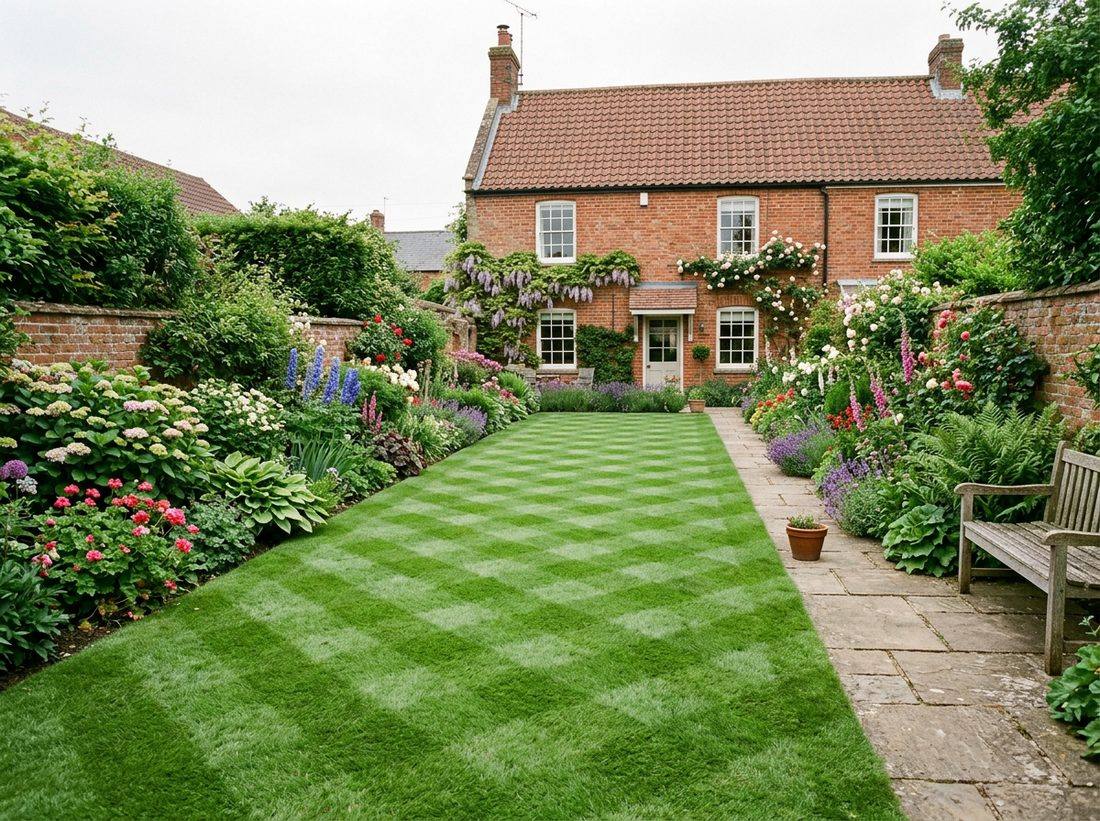
Those crisp light and dark bands on a cricket pitch or a show lawn aren’t two shades of grass. They’re the same grass, bent in opposite directions. Once you know that, getting stripes at home is mostly about bending the grass well, and that comes down to a roller, the right height and straight lines.
How stripes actually work
When grass is pushed flat in one direction, you see more of the broad, shiny side of each blade from one end of the lawn and more of the tips and shadow from the other.
- Grass bent away from you reflects more light and looks lighter.
- Grass bent towards you looks darker.
Walk to the other end of the lawn and the stripes swap. That’s also why stripes look best from the house or the street: pick your viewing spot and mow lines that run towards and away from it.
It’s the roller, not the mower
What bends the grass is a roller behind the blades. That’s why cylinder (reel) mowers, which almost always have a rear roller, are famous for stripes. But plenty of rotary mowers have a rear roller too, and they stripe just as well.
If your mower only has wheels, you’ll get faint stripes at best. Options:
- A striping kit: a clip-on roller or a weighted flap that hangs behind the deck. Many mower makers sell one to fit.
- A separate lawn roller or drag: roll the lines after mowing. Heavier isn’t better; you want to bend the grass, not compact the soil.
Whatever you use, keep the blades sharp. A blunt blade tears the tips, they go whitish-brown, and the whole lawn looks dull.
The right height
You need enough leaf to bend. Very short grass stands up straight and barely stripes; a bit longer gives you more surface to catch the light.
| Grass | Striping height | Stripes? |
|---|---|---|
| Ryegrass, Fescue | 30 to 50 mm | Excellent: long, soft, flexible leaves |
| Kikuyu | 25 to 40 mm | Good when the lawn is dense and evenly mown |
| Bermuda / couch | 15 to 30 mm | Fair; best with a cylinder mower at the higher end |
| Zoysia | 20 to 40 mm | Fair |
| Buffalo | 30 to 50 mm | Faint: broad, stiff leaves don’t bend much |
Two rules apply whatever your grass:
- Never remove more than a third of the leaf in one mow. If the lawn’s got long, bring it down over a few mows.
- Mow when the grass is dry. Wet grass clumps, tears and won’t lie the same way.
Straight lines, step by step
- Mow the edge first. Do one or two laps around the whole lawn. This border (the headland) gives you space to turn without scuffing your stripes.
- Pick your first line. Start along the straightest, longest edge: a path, the patio or the house. If nothing’s straight, run a string line between two pegs.
- Aim at something. Look at a fixed point at the far end, like a fence post or a tree, not at your feet. You’ll walk straighter.
- Overlap a little. Overlap each pass by the width of the wheel, or about 5 cm, so there are no thin missed strips between stripes.
- Turn on the headland. At the end of each line, lift the cutting deck slightly or ease off, turn on the border and line up for the return pass in the opposite direction.
- Finish the edge again. One last lap around the border tidies the turns.
Your first go will wobble. By the third or fourth mow you’ll be lining up on the previous stripe without thinking.
Patterns
Once straight lines are easy, try these:
- Checkerboard: mow straight stripes, then mow the whole lawn again at right angles. Each square shows a different mix of directions.
- Diagonal stripes: start from one corner instead of an edge. Great on small lawns, because diagonals look longer.
- Diamonds: diagonal stripes one way, then diagonal stripes the other way across them.
- Curves and waves: follow a curved bed or path. Harder to keep even, but stunning on a large lawn.
Keeping them sharp
- Change direction each time you mow. Mowing the same lines every week wears ruts and trains the grass to lean one way (grain). Rotate between two or three patterns.
- Freshen them up. Stripes fade as the grass stands up again. Before a braai or a photo, run the roller over the lines again without cutting.
- Morning dew and low evening sun make stripes look their best.
- Feed and water evenly. Stripes show off a dense, even lawn. Thin patches and burn marks show up more, not less.
When stripes go wrong
- Wavy lines. You’re looking down at the mower. Look at your fixed point at the far end, and slow down.
- Thin, scruffy strips between stripes. Not enough overlap. Overlap each pass by a wheel’s width.
- Brown scuffs at the ends. Turning on the lawn instead of the headland, or turning with the blades down. Widen the border and lift the deck as you turn.
- Pale, whitish sheen across the lawn. Blunt blades are tearing the tips. Sharpen or replace the blade.
- Stripes on one half only. The sun has moved, or you’re looking from the side. Stripes show best when you look along them.
The short version
- Stripes are bent grass reflecting light. The roller does the bending.
- Mow a bit higher than you think, and never more than a third at once.
- Edge first, aim at a fixed point, overlap slightly, turn on the border.
- Change the pattern every mow, and keep the blades sharp.
What you’ll need
Generic suggestions, not endorsements. No brand has paid to be here and there are no affiliate links in this box.
- Mower with a rear rollerThe roller does the striping. The blades just cut.
- Striping kit for a rotary mowerA clip-on roller or flap for mowers without one.
- Mower blade sharpening (or a spare blade)Torn tips go white and dull the stripe.
Questions people ask
Do I need a cylinder mower to get stripes?
No. You need a roller behind the blades. Many rotary mowers have a rear roller, and striping kits add one to mowers that don’t. A cylinder mower gives the crispest finish on short, fine lawns.
Why are my stripes so faint?
Usually one of four things: no roller, grass cut too short, a grass type that doesn’t bend much (like Buffalo), or a thin, uneven lawn. Raise the cut a few millimetres and add a roller before anything else.
Does striping damage the lawn?
No, as long as you change direction regularly. Mowing the same lines every week can wear ruts and make the grass lean one way, so rotate between two or three patterns.
How long do mowing stripes last?
A few days, fading as the grass stands back up. Rolling the lines again without cutting brings them back, and they look strongest in morning dew or low evening sun.