
Warm-season grasses do almost all of their growing in the warm half of the year and slow right down, or go dormant, when it’s cold. Get your jobs into the right months and they do most of the work for you. Get them in the wrong months and you’re feeding weeds, scalping a sleeping lawn or aerating holes that won’t close.
This calendar is for Kikuyu, Buffalo and Bermuda (couch) in the southern hemisphere: most of South Africa and Australia. Seasons here run spring September to November, summer December to February, autumn March to May and winter June to August.
First, know your climate
The same grass behaves differently in different places, so treat the months as a guide and watch your own lawn.
- Winter-rainfall areas (the Western Cape, Adelaide, Perth): wet winters and dry, hot summers. Watering matters most from November to March, and water restrictions are common.
- Summer-rainfall areas (Gauteng and the Highveld, much of KwaZulu-Natal, Queensland and New South Wales): storms in summer, dry winters. Highveld winters bring frost, so Kikuyu and Bermuda brown off completely.
- Subtropical coasts (Durban, Brisbane): growth barely stops, so the season is longer at both ends, and fungus is more of a problem in humid summers.
The rule underneath all of it: do the hard jobs when the grass is growing hard, so it recovers fast.
The year at a glance
| Month | Main jobs |
|---|---|
| September | Clean up, first mows, pre-emergent weed control, first feed once growing |
| October | Scarify and aerate (Kikuyu, Bermuda), feed, start regular mowing |
| November | Aerate, top-dress and level, feed if you didn’t in October |
| December | Mow often, water deeply, light feed, watch for fungus |
| January | Peak growth: mow, water, watch for lawn caterpillars |
| February | Keep mowing, top up the summer feed, last levelling |
| March | Autumn feed, raise the mower, autumn weed control |
| April | Final feed (high in potassium), last aeration in mild areas |
| May | Raise mowing height again, rake leaves, water less |
| June | Rest: little mowing, little water, keep traffic off frost |
| July | Rest, service the mower, sharpen the blades |
| August | Plan, soil test, pre-emergent in late August, light clean-up |
Spring: September, October, November
September. The lawn is waking. Rake out dead material, pick up winter debris and give it a first mow a notch lower than your winter height, without scalping into brown stems. Late August to mid-September is the time for a pre-emergent weed control if summer weeds are a problem, because it stops seeds germinating rather than killing what’s there. Wait for real growth before the first feed.
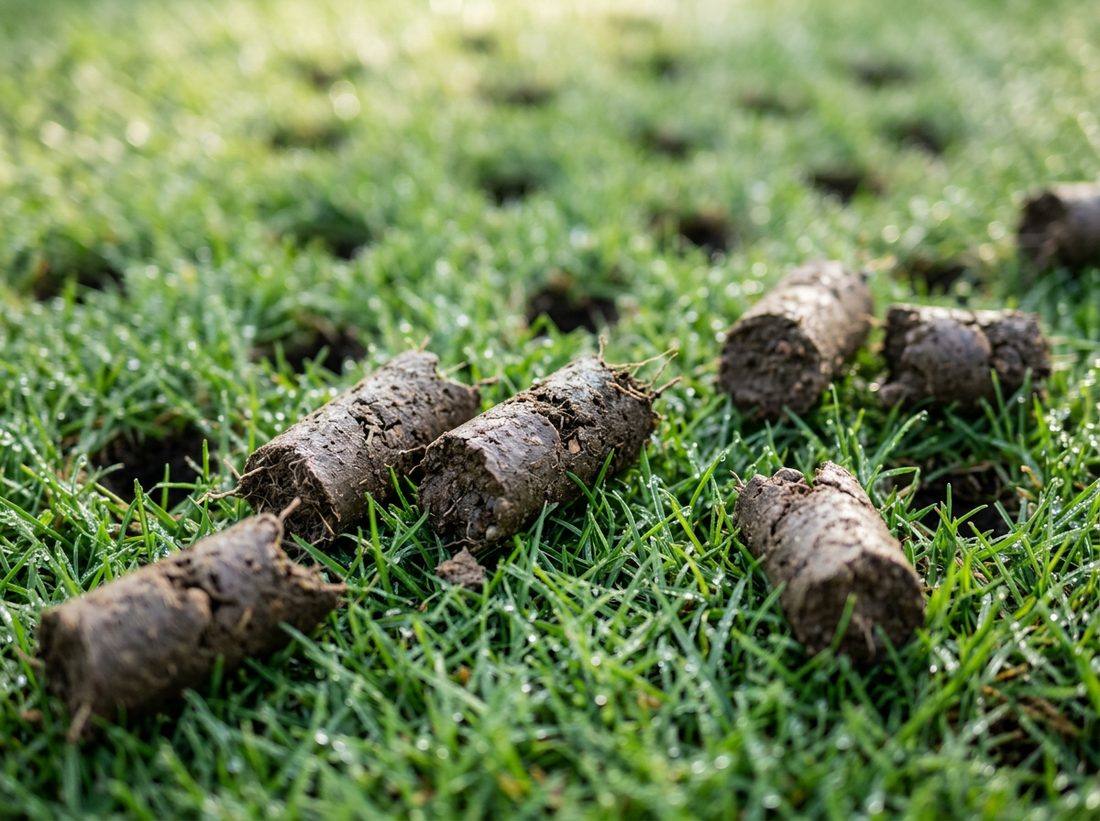
October. Growth takes off. This is the classic month to scarify Kikuyu and Bermuda, cutting out the thatch that built up last year, then core-aerate. Feed with a balanced lawn fertiliser at the rate on the bag and water it in. Settle into a mowing rhythm: never take more than a third of the leaf height at once.
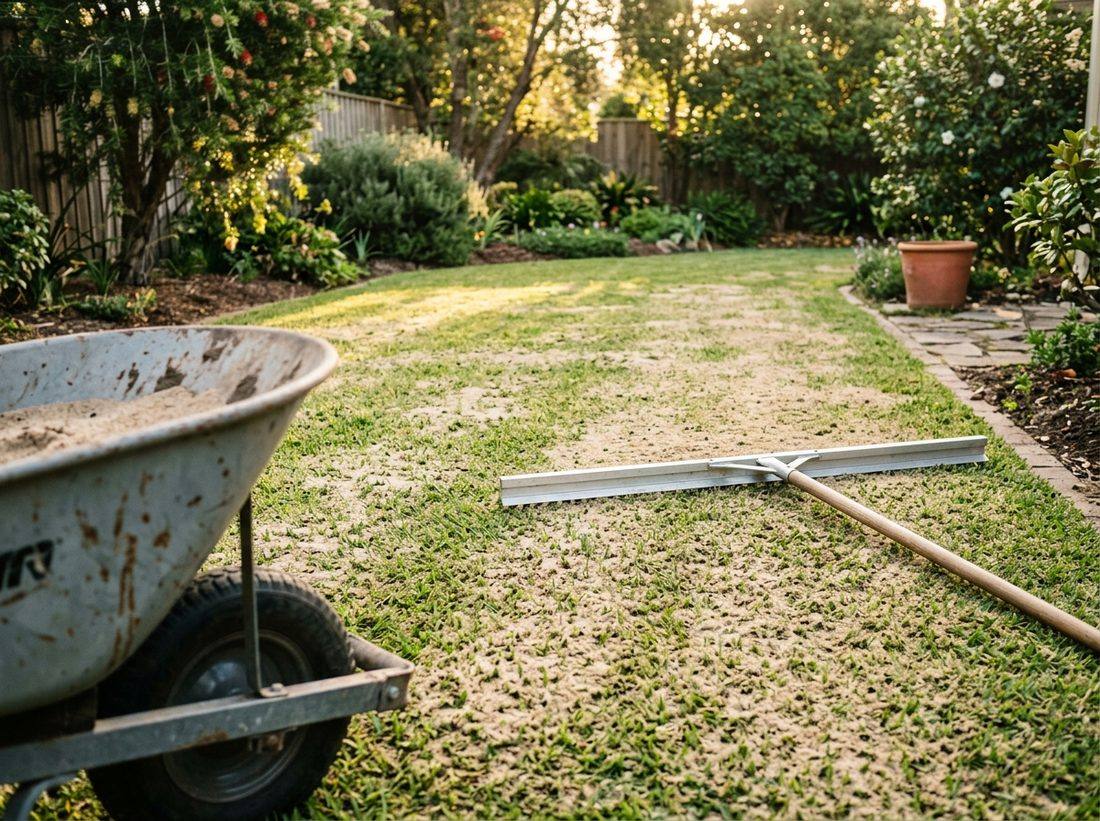
November. Kikuyu and Bermuda are running. If you haven’t aerated, do it now. Follow with top-dressing, the best fix for bumps and hollows, while the grass grows fast enough to come through the sand in a week or two.
Buffalo needs a gentler spring. It spreads by thick runners that sit on top of the soil, so don’t scarify it hard or scalp it: a light rake and a lower mow is plenty. Aerating and top-dressing are fine.
Summer: December, January, February
December. Mowing season proper. Kikuyu and Bermuda can need a cut every five to seven days. Typical home heights:
| Grass | Summer mowing height |
|---|---|
| Kikuyu | 25 to 40 mm |
| Buffalo (soft-leaf) | 30 to 50 mm, higher in shade |
| Bermuda / couch | 15 to 30 mm (lower with a cylinder mower) |
Water deeply and less often rather than a little every day: about 25 mm a week including rain, in one or two sessions, early in the morning. Deep watering grows deep roots. Follow your local water rules.
January. Peak heat and peak growth. Raise the cut a few millimetres in a heatwave. Watch for lawn caterpillars (armyworm): patches that look chewed and brown almost overnight, with birds working the lawn. In humid, wet spells, look out for fungal patches, and water in the morning so the grass dries during the day.
February. Keep mowing and watering. A light summer feed now carries the lawn into autumn. It’s your last good chance to level and top-dress before growth slows.
Autumn: March, April, May
March. Feed again. This autumn feed helps the lawn store energy and stay green longer. Raise the mower a notch as days shorten. Apply an autumn pre-emergent if winter weeds like winter grass (Poa annua) take over each year.
April. Last feed of the year, ideally one higher in potassium, which helps with cold and disease. In mild coastal areas, a light aeration is still fine. Spot-treat broadleaf weeds while they’re growing, using a product labelled safe for your grass.
May. Growth slows. Raise the height again, because longer leaves help a warm-season lawn through winter. Rake up leaves so they don’t smother the grass, and water much less.
Winter: June, July, August
June and July. Rest. Kikuyu and Bermuda may go fully dormant and brown, especially on the frosty Highveld. That’s normal. Mow only if it’s still growing, keep off frosty grass (footprints become brown marks), and water only in long dry spells in summer-rainfall areas. No nitrogen feeds.
Use the quiet months to service the mower: sharpen or replace the blade, change the oil, check the roller.
August. Plan the season. A soil test every year or two tells you whether you need lime, phosphorus or just nitrogen. Order your sand if you’ll be levelling in spring. Late August, in warmer areas, is the start of pre-emergent time again.
Three habits that matter more than any month
- Feed only a growing lawn. Fertiliser on a dormant lawn feeds weeds, not grass.
- Never cut more than a third. It’s the fastest way to a thin, weedy lawn.
- Water deep, not daily. Shallow daily watering grows shallow roots and invites fungus.
What you’ll need
Generic suggestions, not endorsements. No brand has paid to be here and there are no affiliate links in this box.
- Push or hand-held spreaderEven spreading is the difference between green and striped-with-burn.
- Slow-release lawn fertiliserFor the spring, summer and autumn feeds.
- Soil test kit (pH and nutrients)Once every year or two, so you feed what the soil actually needs.
- Rain gauge or tuna tinsTo know how much water your lawn really gets.
Questions people ask
When does a warm-season lawn wake up?
When the soil warms to about 15 to 18 °C, usually in September or October in South Africa and southern Australia, earlier in subtropical places like Durban and Brisbane. New green shoots and the need to mow are the sign. Feed once it’s growing, not before.
Should I fertilise in winter?
Not with a high-nitrogen feed. A dormant or slow warm-season lawn can’t use it, so it washes away or feeds winter weeds. In mild areas where the lawn stays green, a light autumn feed higher in potassium is enough to carry it through.
Can I use the same weed killer on Buffalo as on Kikuyu?
Not always. Buffalo is damaged by some common broadleaf weed killers, especially those containing dicamba. Use a product whose label says it’s safe for Buffalo, and check the label for every grass you use it on.
Why is my Bermuda lawn brown in winter?
That’s normal. Bermuda (couch) goes dormant and straw-coloured when it gets cold, especially after frost. It greens up again in spring. Keep traffic off frosty grass and don’t feed it until it’s growing.
Does this calendar work for the northern hemisphere?
Shift every month by six. Spring jobs listed here for September to November happen from March to May up north.