A yellow patch is your lawn telling you something’s wrong. The trouble is that fertiliser burn, fungus and a dry spot can look alike from the kitchen window, and the fixes are opposites: one needs lots of water, one needs less, and feeding makes two of the three worse.
So before you reach for anything, play detective. Four clues sort out most cases: when it started, its shape, what the blades look like and what the soil feels like.
The quick guide
| Clue | Fertiliser burn | Fungus | Dry spot |
|---|---|---|---|
| When it appeared | 1 to 5 days after feeding | After warm, humid or wet weather | During heat or a dry spell |
| Shape | Stripes, spots or a spill shape; follows where you walked | Rings or roundish patches that grow | Matches sprinkler gaps: edges, slopes, between heads |
| Blades | Brown, crispy tips; no spots | Spots or lesions, sometimes fine white threads in the morning | Folded, bluish-grey before yellowing; footprints stay |
| Soil | Normal | Often damp | Hard and dry |
| Spreading? | No | Yes, often at the edges | Only if the dry weather continues |
Fertiliser burn
Fertiliser is a salt. Too much in one place draws water out of the grass, and it scorches.
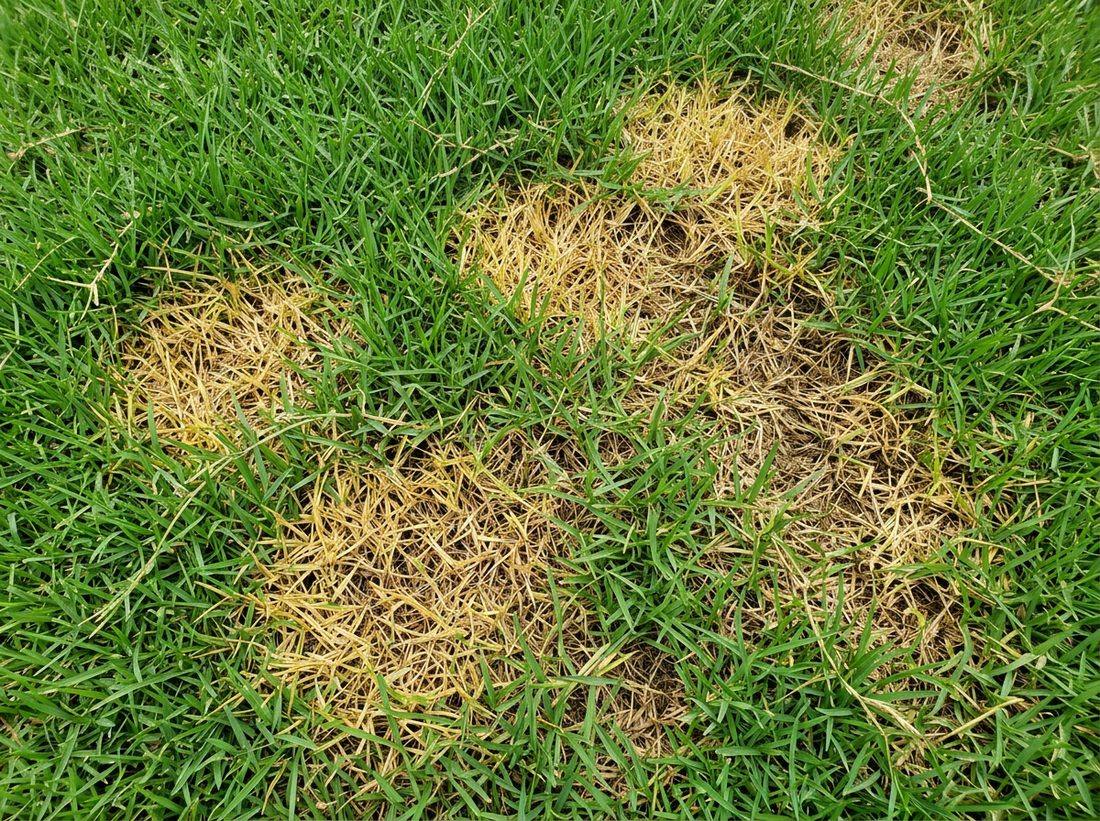
Signs: Yellow or straw-brown patches appear within a few days of feeding. They’re often in lines where your spreader overlapped, in dots where granules clumped, in a blob where the bag spilled, or at the ends of rows where you turned. The tips go brown and crisp first. The edges of the patch are sharp and it doesn’t spread. Dog urine does the same thing in round spots, often with a dark green ring around them.
Fix:
- Water heavily, about 25 mm, straight away, and again daily for three or four days, to flush the salts below the roots.
- Don’t feed again for at least six weeks.
- Wait. If the crowns at the base are still pale green, the grass will recover. Kikuyu and Bermuda send runners in from the edges within a few weeks.
- If it’s truly dead, rake it out and top-dress or patch it once the area has been flushed.
Prevent it: Use a spreader, set it to half the rate and go over the lawn twice at right angles. Water in straight after feeding, and never feed a dry, stressed lawn.
Fungus
Lawn fungi love warm, humid weather, wet leaves and too much nitrogen. In warm-season lawns the usual suspects are large patch (brown patch) in the cooler, wetter weeks of spring and autumn, dollar spot, and spring dead spot in Bermuda.
Signs:
- Rings or roundish patches that grow over days, often with a darker or orange-brown edge, especially visible in the morning.
- Lesions on the blades: tan spots with a darker border, or blades that rot at the base. With large patch, the yellow leaves pull out easily from the stem.
- Fine, cobweb-like white threads across the grass on dewy mornings.
- It started after a humid spell, or you water in the evening, or the area is shaded with little air movement.
Fix:
- Water in the early morning only, deeply and less often, so the grass dries quickly. Stop evening watering.
- Hold off nitrogen. Lush, soft growth feeds fungus. An autumn feed higher in potassium is fine.
- Improve air and drainage. Aerate compacted soil, cut back overhanging plants, remove thatch.
- Collect clippings from infected areas so you don’t spread it, and wash the mower afterwards.
- If it keeps spreading, use a lawn fungicide labelled for that disease and your grass type, exactly as the label says. Identify it first: a fungicide won’t fix burn or a dry spot.
Fungal patches often recover by themselves once the weather turns, as long as you stop feeding them water and nitrogen.
Dry spots and irrigation
The most common cause of all, and the easiest to fix.
Signs: The grass looks dull and bluish-grey before it yellows. Blades fold or curl lengthways. Walk on it and your footprints stay pressed in for minutes. The soil is hard, and a screwdriver won’t go in. The patches line up with your watering: the edges near hot paving and walls, slopes and raised areas, the corners sprinklers don’t reach, or the gaps between two sprinkler heads.
Check your coverage: put five or six empty tins (tuna tins are perfect) across the lawn, run your sprinklers for 15 minutes and compare. Big differences mean a blocked, tilted or badly spaced head.
Fix:
- Water deeply: about 25 mm a week in hot weather, in one or two sessions, early in the morning, within your local water rules.
- Fix the sprinklers: clean nozzles, straighten heads, add one where there’s a gap.
- Water-repellent sand. Sandy soils, common in the Western Cape and Perth, can repel water once they dry out completely, so water runs off. A soil wetting agent helps water soak in again. Core aeration helps too.
- Look underneath. A patch that dries out first every summer may be sitting on builder’s rubble, a rock or a shallow layer of soil.
Other suspects
- The whole lawn is pale. It’s probably hungry: a nitrogen shortage. Yellowing between green veins on new growth can mean iron deficiency, common in alkaline soils.
- Patches that lift like carpet. Grubs (beetle larvae) eat the roots. Check by peeling back the turf.
- Chewed, brown patches that appear overnight in late summer, with birds feeding on them. Lawn caterpillars (armyworm). Soak a square metre with a bucket of water mixed with a squirt of dishwashing liquid: if caterpillars come to the surface within a few minutes, that’s your answer.
- Shade. Warm-season grasses thin and yellow with less than four to six hours of sun a day.
- Spills. Petrol, oil, weed killer or pool water kill grass in the exact shape of the spill.
Before you treat anything
- Think back: what did you do, and what was the weather, in the week before it appeared?
- Look closely at the blades and the edge of the patch.
- Push a screwdriver into the patch, and into healthy lawn nearby.
- Take a photo now and another in three days. Is it growing?
Most yellow patches are dry spots or burn, and both recover with the right water. Fungus is real, but it’s rarely the first answer.
What you’ll need
Generic suggestions, not endorsements. No brand has paid to be here and there are no affiliate links in this box.
- Soil probe or long screwdriverTells you in seconds whether a patch is dry.
- Rain gauge or tuna tinsShows which parts of the lawn your sprinklers miss.
- Push or hand-held spreaderThe best way to prevent burn next time.
- Lawn fungicide labelled for your grassOnly once you are sure it is fungus.
Questions people ask
Will the yellow patches grow back?
Usually, yes. If the base of the grass is still pale green, it will recover once you fix the cause. Kikuyu, Bermuda and Buffalo also spread back in from the edges with runners. Truly dead patches can be top-dressed or patched in the growing season.
Should I fertilise a yellow lawn?
Not until you know why it’s yellow. Feeding makes fertiliser burn worse and feeds fungus. Only a lawn that’s evenly pale all over, and growing, is likely to be asking for food.
How do I know if it’s fungus?
Look for patches that grow over a few days, rings with a darker edge, spots or lesions on the blades, or fine white threads on dewy mornings, usually after warm, humid or wet weather. If a patch is crisp and dry and the soil is hard, it’s far more likely to be thirst.
How do I fix dog urine spots?
Flush the spot with plenty of water as soon as you can, ideally the same day. Spots that have already died can be raked out and top-dressed. Watering the area after your dog goes, or training it to use one spot, prevents most of them.
Why are there yellow stripes after I fertilised?
Overlapping passes with the spreader doubled the dose in those strips and burnt the grass. Water heavily for a few days to flush it, and next time spread at half the rate in two directions at right angles.